Why This Matters for the U.S. Too
International Students as Essential, Not Optional
The AAU & Business Roundtable report shows that international students are essential contributors to U.S. research, innovation, and also economic growth. At many universities, especially in STEM fields like computer science, engineering, and biotechnology, international students make up more than 50% of graduate enrollment. In several college towns such as Austin, Ann Arbor, or Madison, this presence also translates into billions in economic activity, as shown in NAFSA’s infographic below illustrating how international students contribute to the U.S. community.
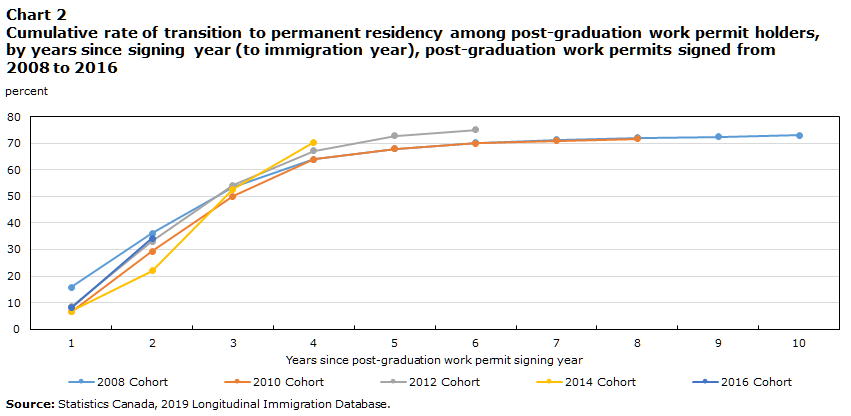
However, the report also warns that despite this impact, international graduates face uncertain and sometimes impossible pathways to remain in the U.S. after finishing their degree. OPT provides only a short window of work authorization, and employer confusion about “sponsorship” often discourages companies from hiring qualified candidates. When compared to some countries like Canada; which offers multi-year work permits (as shown in the Statistics Canada chart where nearly 75% of PGWP holders transition to permanent residency). As a result, many talented graduates who want to stay and contribute in America are pushed to more welcoming countries.
This chart in the Statistics Canada report shows what happens to international graduates in Canada after they finish school and receive a Post-Graduation Work Permit (PGWP).
https://www150.statcan.gc.ca/n1/pub/36-28-0001/2021012/article/00002-eng.htm?utm_source
Economic & Jobs Impact of International Students to the U.S.
This NAFSA infographic illustrates how international students contribute to the U.S. economy and innovation. It highlights that international students contributed nearly $38.7 billion to the U.S. economy and supported around 416,000 jobs, even though they represent only about 5.5% of total U.S. college enrollment.
It also notes that nearly one-quarter of the founders of U.S. billion-dollar startups first came to America as international students. Instead of seeing international students as guests or temporary tuition payers, this graphic offers the audience a different view to recognize international students as long-term drivers of innovation and job creation; if the system allows them to stay.
Solutions & Policy Recommendations: What Could Change?
1. National Policy Changes:
- Stabilize and extend post-study work options: Instead of treating OPT as a short-term opportunity, U.S. policy could move closer to the Canadian PGWP model, which is offering multi-year work authorization after graduation. This would give employers more time to see what an international employees got and what they can contribute to the company.
- Create a clearer path from study to permanent residency: The Canadian data show that when a country offers a realistic route to stay, many international graduates become permanent residents and continue contributing to the economy. The U.S. can apply a similar pathway in order to keep talented people for the country.
- Provide better public guidance for employers: Many employers avoid hiring international students because they misunderstand visa rules. In that case, federal agencies and national organizations could publish some simple, widely promoted guidance explaining how OPT and work visas actually function for better understanding.
2. University-Level Commitments:
- Immigration-informed career services: Research by Weiner & Ghazarian and Domínguez et al. shows that international students often feel unprepared and unsupported in the job search. Universities should train career advisors on CPT/OPT, H-1B basics, and common employer questions, instead of expecting students to figure this issue alone.
- Dedicated job-search programming for international students: Offer more workshops, employer panels, and mentoring programs specifically around visa timelines, sponsorship conversations, and cross-cultural workplace expectations for international students before they finishing their programs.
- Strategic partnerships with “visa-friendly” employers: Universities can definitely build relationships with several organizations that have experience hiring international graduates, and then highlight those options to students.
3. Employer Practices:
- Stop automatically screening out foreign applicants: A lot of businesses employ application processes that automatically turn down anyone who isn’t a citizen or permanent resident. Taking away such filters is a simple first step toward fairness.
- Don’t see OPT as a burden; see it as an opportunity: Employers might think of OPT as a low-risk trial period. They can work with a foreign graduate for a year or more before choosing whether to sponsor them for a longer amount of time.
- See global experience as a plus: International students have bilingual abilities, cultural knowledge, and experience working with complicated systems, which is exactly the type of flexibility that many employers claim they want.
4. Community and Campus Advocacy:
Finally, students, faculty, and staff can:
- Encourage institutions to keep track of results: Universities may keep track of the job and internship outcomes for overseas students and make that information public. When gaps show up, they are harder to ignore and simpler to plan around.
- Share stories that can make policy more human: Studies demonstrate that structural obstacles have a big impact on mental health and feeling like you belong. When kids write, draw, or talk about their stories, they show others that these aren’t just personal problems, but something that everyone goes through and that need to change.
 International Students and their challenges